What Are Bulk Carrier Ships? Types, Sizes, & How They Work
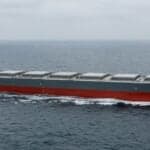


One in every five merchant ships afloat right now is a bulk carrier, which represents around 21% of the commercial fleet in the world. These specialised vessels carry loose bulk commodities in massive weather-tight holds and feature a simple propulsion system and the ability to easily load and unload cargo, which comprises iron ore, coal and grain.
Bulk Carriers usually move iron ore from Brazil to Chinese steel mills, coal from Australia to Asian power stations, and grain from the American prairies to North African ports.
What Is a Bulk Carrier?
Bulk carriers, or bulkers as they are commonly called, are purpose-built vessels to transport unpackaged and dry cargo in massive quantities.
The cargo is directly loaded into the ship’s holds without any packaging in bags, drums or containers. Then it is unloaded from the ship using cranes, conveyor belts or the ship’s own onboard equipment.
Bulk carriers have a long, flat weather deck interrupted by a row of large rectangular hatch covers, an accommodation block and bridge positioned at the stern, and no cargo-handling superstructure amidships unless the vessel is geared. Below deck, the holds have no ‘tween decks, and the interior is a single open space designed to accept loose cargo in the largest possible volume.
Bulk carriers are different from break-bulk ships as they carry individually packaged or unitised cargo. They are also distinct from container ships, which transport goods packed in standardised containers, which are of different types depending on the type of cargo.
The first purpose-built bulk carrier was the British collier John Bowes, launched in 1852. It introduced 3 features that remain standard today: a metal hull, steam-powered propulsion, and a seawater ballasting system that allowed the vessel to load water into its holds on return journeys to maintain stability.
The first self-unloading bulk carrier was the lake freighter Hennepin, which entered service in 1902 on the Great Lakes.
Fleet at a glance: Bulk carriers make up approximately 21% of the world’s merchant fleet. The global fleet of dry bulk vessels exceeds 12,000 ships above 10,000 DWT. Maximum capacity reaches 403,818 DWT for the largest ore carriers in service.
What Do Bulk Carriers Transport?

The major bulks, i.e., iron ore, coal, and grain, account for the majority of all dry bulk trade by tonnage. The largest volume of iron ore moves from Brazil and Australia to China, where it is used to produce steel.
Coal, used to generate electricity and also steel, is another top commodity transported by bulk carriers, followed by grain, including wheat, corn, soybeans, and rice, which the United States, Brazil, Argentina, and Ukraine export to the Middle East, Asia and Africa.
The minor bulks includes fertilisers, cement, bauxite and alumina, sugar, timber, steel coils, salt, and petcoke.
Some of these, particularly cement and sugar, require specialised vessel configurations because they can be ruined by moisture and are discharged in a specific form.
Cargo density is a critical variable in bulk carrier design and operation. Light grains weigh approximately 0.6 tonnes per cubic metre, meaning the vessel’s cubic capacity fills before its weight capacity is reached.
Iron ore, at approximately 3 tonnes per cubic metre, does the opposite. The weight limit is reached while significant hold volume remains unused.
This contrast drives the different hold geometries between ore carriers and grain carriers, and determines how holds are partially filled or loaded in alternating patterns to manage structural stress.
Bulk Carrier Size Classes

Bulk carriers are classified mainly by deadweight tonnage (DWT); the total weight of cargo, fuel, water, stores, and crew the vessel can carry. They are also divided into sub-classes, which often reflect specific port or waterway constraints.
Mini Bulk Carriers (500–10,000 DWT)
Mini bulk carriers or coasters operate in coastal and short-sea trades, serving smaller ports with limited draft and berth length.
They are usually less than 110 metres long and have a maximum draft of under 10 metres. They are almost universally geared, carry their own cranes, and call at ports that cannot accommodate larger vessels.
Handysize (10,000–40,000 DWT)
The Handysize class comprises the largest chunk in the entire bulk carrier fleet, which is almost 34% of the total.
Handysize bulk carriers are 110 to 150 m long and can berth at the widest range of ports across the world, including facilities in Africa, Southeast Asia, and South America that lack the infrastructure for larger ships.
Handysize bulk carriers are generally geared and versatile, capable of carrying grain, fertiliser, steel products, and minor bulk commodities.
Handymax, Supramax, and Ultramax (40,000–70,000 DWT)
Handymax vessels, with a DWT of 40,000–59,000, represent the original designation; whereas Supramax (50,000–65,000 DWT) and Ultramax (60,000–70,000 DWT) are successive refinements with improved cargo gear and hold configurations.
Together, they account for approximately 37% of the global bulk carrier fleet. Most are equipped with four or five cranes of 25–35 tonne capacity, making them self-sufficient at ports with no shoreside equipment.
Panamax and Kamsarmax (70,000–100,000 DWT)
Panamax bulk carriers are built so they can fit the original Panama Canal locks. They are 32.3 m wide, 294 m long and have a 12 m draft.
They represent approximately 19% of the fleet and are primarily deployed in coal and grain trades.
Kamsarmax is a sub-class with lengths limited to 299 m to fit the berths at the Port of Kamsar in Guinea, a major bauxite export terminal.
Despite the length constraint, Kamsarmax vessels can reach 82,000 DWT due to optimised beam and depth.
New Panamax vessels, designed for the expanded canal locks opened in 2016, can reach 120,000 DWT with a beam of 49 metres, substantially larger than the original Panamax limit.
Capesize (100,000–200,000 DWT)
Capesize vessels are too large to transit either the Panama or Suez Canals and must route around Cape Horn or the Cape of Good Hope, hence the name.
They account for approximately 10% of the fleet by number but carry roughly 62% of bulk cargo by weight, primarily iron ore and coal on the high-volume deep-sea trades.
A typical modern Capesize vessel measures 250 to 300 metres in length and loads at a small number of dedicated deep-water terminals.
The Newcastlemax sub-class is sized to the berths at Newcastle, Australia, the world’s largest coal export port, with a maximum length of 300 metres, beam of 50 metres, and capacity of around 185,000 DWT.
VLOC and Valemax (200,000–403,818 DWT)
Very Large Ore Carriers (VLOCs) represent the upper limit of bulk carrier size. The Valemax class, developed by the Brazilian mining company Vale specifically for the Brazil-to-China iron ore run, is the largest bulk carrier class in operation.
These vessels are 361–365 m long, 65.64 metres wide and carry up to 403,818 DWT. The fleet includes vessels such as Sea Beijing and Sea Qingdao, operating under long-term contracts between Vale and Chinese steel producers.
Port-constrained sub-classes extend across other waterways: the Seawaymax class fits the St. Lawrence Seaway locks at 226 metres LOA; the Malaccamax class is sized to the draft limit of the Strait of Malacca at 333 metres and approximately 300,000 DWT; the Chinamax standard applies to major Chinese deep-water terminals at up to 360 metres length; and the Dunkirkmax class fits the port of Dunkirk at around 175,000 DWT.
Bulk Carrier Size Classes —A Quick Reference
| Class | DWT Range | Typical Length | Key Constraint | Primary Cargo |
|---|---|---|---|---|
| Mini Bulk | 500–10,000 | Under 110m | Coastal ports, shallow draft | Minor bulks, aggregates |
| Handysize | 10,000–40,000 | 110–150m | None — widest port access | Grain, fertiliser, steel |
| Handymax/Supramax | 40,000–65,000 | 150–200m | Most mid-size ports | Coal, grain, minor bulks |
| Ultramax | 60,000–70,000 | 190–200m | Most mid-size ports | Coal, grain, steel |
| Panamax | 65,000–80,000 | Up to 294m | Panama Canal (original locks) | Coal, grain |
| Kamsarmax | Up to 82,000 | Max 229m | Port of Kamsar, Guinea | Bauxite, coal |
| Capesize | 100,000–200,000 | 250–300m | Cannot use Panama/Suez | Iron ore, coal |
| Newcastlemax | ~185,000 | Max 300m | Newcastle, Australia | Coal |
| VLOC/Valemax | 200,000–403,818 | 361–365m | Dedicated deep-water terminals | Iron ore |
Types of Bulk Carriers by Design

Beyond size, bulk carriers are classified by their cargo-handling capabilities and structural configuration.
Geared Carriers
Geared bulk carriers have their own cargo-handling equipment, including cranes, derricks, or conveyor booms mounted on deck.
Most Handysize and Supramax vessels are geared, carrying four or five cranes capable of lifting 25–40 tonnes per cycle.
This self-sufficiency makes them deployable at underdeveloped ports that lack shoreside equipment, giving them greater trading flexibility than larger, gearless vessels.
Gearless Carriers
Gearless carriers rely entirely on port infrastructure for loading and discharging. All Capesize, VLOC, and most Panamax vessels fall into this category.
Without the weight and cost of onboard cranes, gearless vessels can maximise cargo capacity and speed, but they are confined to the small number of ports worldwide equipped with the heavy-lift gantry cranes and conveyor systems capable of handling their volumes.
Self-Dischargers
Self-discharging bulk carriers are equipped with internal conveyor belt systems that move cargo from the holds, up through the ship, and discharge it via an extendable boom onto the berth or into a receiving facility. Discharge rates typically reach around 1,000 tonnes per hour. Self-dischargers are used extensively on the Great Lakes and in coastal aggregate trades where port equipment is minimal or absent.
Combined Carriers (OBO)
Ore/Bulk/Oil carriers are designed to transport either dry bulk commodities or liquid cargo, crude oil or heavy fuel oil, depending on the voyage.
The conversion between cargo modes requires thorough tank cleaning, which is time-consuming and expensive. OBO carriers now represent less than 3% of combined fleet capacity; their appeal has diminished as both the tanker and dry bulk markets developed specialised tonnage.
Open Hatch Bulk Carriers (OHBC)
Open hatch vessels feature hatch openings that span nearly the full width of the vessel, allowing direct crane access to the full hold volume without repositioning. This design is used primarily for forest products, paper rolls, and other cargo that must be loaded and discharged without damage from conventional grab operations. The hatch cover panels are typically stored on deck or pushed aside rather than folded.
BIBO Carriers
Bulk In, Bags Out carriers perform a packaging operation during discharge: bulk cargo loaded at the origin port is bagged, typically into 50-kilogram sacks, as it is discharged at the destination.
The CHL Innovator can discharge 300 tonnes of sugar per hour while simultaneously packaging it into 50-kilogram bags; a capability that serves markets where bulk receiving infrastructure is absent but consumer-ready packaging is required.
Lakers
Lakers are bulk carriers purpose-built for the Great Lakes and St. Lawrence Seaway system in North America.
They are constrained by the Seaway lock dimensions to a maximum of 226 metres in length and 23.8 metres in beam, but are optimised within those limits, some reaching 300 metres on the lakes themselves where no lock dimensions apply.
Lakers experience lower corrosion rates than ocean-going vessels due to their freshwater operating environment.
Key Design Features

Bulk carrier design is governed by the need to carry dense, abrasive, or shifting cargo safely while minimising structural weight and operational complexity.
Cargo holds are large, unobstructed spaces with no ‘tween decks. Most Capesize and VLOC vessels have 9 holds; smaller vessels typically have 5 to 7.
The absence of internal decks maximises cubic capacity and allows loading by conveyor or grab without obstruction.
Hopper tanks are the defining structural feature of the bulk carrier hold. Upper hopper tanks or topside tanks run along the upper inboard corners of each hold, sloping inward and downward.
Lower hopper tanks at the bilge slope upward toward the centreline. Together, they create a tapered hold profile that causes cargo to flow toward the centreline under gravity, making the hold self-trimming, reducing the manual redistribution of cargo needed to achieve even stowage, particularly important for grain.
Hatch covers occupy 45–60% of the ship’s breadth on modern vessels. They must be weathertight under the 1966 Load Line Convention (minimum 1.74 tonnes/m² water resistance) and meet the enhanced International Association of Classification Societies Unified Requirement S21, which increases standards based on freeboard and speed.
Modern hatch covers are hydraulically operated metal panels that can typically be opened and closed by one person. Hatch cover deterioration was identified as a primary cause of the catastrophic sinkings of the 1990s.
Double-bottom construction has been universal since 1890. The space between the outer hull bottom and the inner tank top houses ballast water tanks. Modern vessels combine the double bottom with longitudinal double-side construction, creating a full double hull that provides an additional barrier against flooding following grounding or collision.
Ballast tanks are essential because bulk carriers frequently sail empty since a vessel that loaded grain in the United States and discharged it in Egypt must sail back empty to load again.
Ballast water fills the double bottom, hopper tanks, and topside tanks to bring the vessel down to a safe operating draft. The distribution of ballast affects trim, stability, and structural stress; the GM (metacentric height) must be maintained within safe limits for all loading conditions.
Propulsion on most bulk carriers is a single, two-stroke low-speed crosshead diesel engine driving a fixed-pitch propeller at approximately 90 revolutions per minute.
Design speeds range from 13.5 to 15 knots for Handysize and above. The simplicity of the single-engine, single-propeller arrangement minimises maintenance costs, which is important for a vessel type where operating margins are thin.
Hull geometry follows a consistent proportional logic: length-to-beam ratios of 5–7 (average 6.2) and length-to-depth ratios of 11–12.
Hull material is predominantly mild steel; high-tensile steel is used in some sections to reduce structural weight, though it is more susceptible to fatigue cracking under repeated cargo loading cycles.
Cargo Loading and Unloading

Cargo handling is the operational bottleneck that distinguishes bulk carrier economics from container shipping. Loading and discharge times are long, port stays are expensive, and the handling method varies significantly by cargo type, terminal, and vessel class.
Loading is almost entirely a shoreside function. Conveyor systems and ship-loaders deliver cargo from stockpiles through the hatch openings into the hold. Advanced terminals, particularly iron ore and coal export facilities in Australia, Brazil, and South Africa, achieve loading rates of up to 16,000 tonnes per hour.
A Capesize vessel loading iron ore at Port Hedland in Western Australia can complete loading in under 24 hours at peak throughput.
Discharge is more variable. Shore-mounted gantry cranes with grabs operate at around 2,000 tonnes per hour; double-articulation cranes achieve approximately 1,000 tonnes per hour; conveyor belt discharge at receiving terminals can manage 100–700 tonnes per hour for standard facilities. The implication for port time is significant:
| Vessel Type | Average Port Time |
|---|---|
| Container ship | ~12 hours |
| Car carrier | ~15 hours |
| Tanker | ~26 hours |
| Handymax bulk carrier | ~74 hours |
| Panamax bulk carrier | ~120 hours |
Self-discharging vessels reduce dependence on port infrastructure entirely but are most competitive in coastal trades where high-capacity shore equipment is unavailable.
Cargo trimming, the redistribution of cargo within holds to achieve even stowage and prevent shifting, adds time to every loading operation for non-self-trimming cargoes.
Grain, which flows freely, is largely self-trimming in holds with hopper geometry. Coal and iron ore are less prone to shift but require careful draft surveying before departure.
Bulk Carrier Safety and Regulations

No other ship type has a safety record as starkly defined by a single decade as the bulk carrier.
Between 1990 and 1997, 99 bulk carriers sank worldwide. Over 650 sailors were killed.
The losses triggered the most significant revision of international bulk carrier safety standards since the adoption of SOLAS.
The mechanism of loss was identified by the American Bureau of Shipping and other classification societies as cascading structural failure. The typical sequence:
- Seawater enters a forward cargo hold through a deteriorated hatch cover, a large wave impact, or corrosion-induced structural failure
- The additional water weight compromises the transverse bulkhead separating that hold from the adjacent one
- Water floods the second hold, altering the vessel’s trim dramatically
- With two forward holds flooded, the bow submerges; the vessel sinks in minutes, too fast for the crew to abandon ship
The structural cause was compounding neglect: a glut of ageing vessels built during the 1970s boom, many over 20 years old, with hatch covers corroded beyond safe service.
Advanced loading equipment had also increased cargo loading speeds without corresponding attention to the stress concentrations this created in the hull.
SOLAS Chapter XII water ingress alarm thresholds: Alarms are required in each cargo hold at a water level of 0.5 metres above the inner bottom, and again when the level reaches no less than 15% of hold depth (maximum 2.0 metres). Both thresholds trigger audible and visual alarms.
Regulatory response:
- 1997 SOLAS Chapter XII — the dedicated bulk carrier safety chapter introduced reinforced transverse bulkheads, mandatory corrosion-focused inspections, and routine in-port surveys
- 2002 — High-level water ingress alarms made mandatory on all bulk carriers
- 2004 — Free-fall lifeboats required on Panamax and Capesize vessels
- 2006 — Common Structural Rules (CSR) took effect for vessels over 90 metres, incorporating corrosion margins of 0.5–0.9 mm into structural calculations
- Hull markings — Restricted bulk carriers required to display large triangular hull markings visible from the dock
The combined effect of these measures dramatically reduced the sinking rate during the 2000s. Modern bulk carriers built under CSR are structurally significantly more robust than the generation that dominated the 1990s fleet.
Bulk Carrier Fleet and Ownership

The bulk carrier fleet is concentrated in the hands of a small number of dominant maritime nations, while the vessels themselves are built almost exclusively in three Asian countries.
Fleet ownership (top three nations account for over 53% of the global fleet)
| Country | Vessels Owned |
|---|---|
| Greece | 1,326 |
| Japan | 1,041 |
| China | 979 |
Greek shipowners dominate despite operating no major domestic iron ore or coal trades. Their fleet serves third-party charterers on the global spot and time-charter markets.
Japanese owners frequently operate under long-term contracts with steel mills and power utilities.
Chinese ownership has grown substantially since 2000, driven by the country’s position as the world’s largest importer of iron ore and coal.
Construction is dominated by three countries. Japan historically built the largest share of bulk carriers; South Korea ranked second; China’s shipbuilding industry expanded rapidly in the 2000s and now builds the majority of new bulk carriers by volume.
Together, these three nations account for over 82% of the global bulk carrier fleet by vessels built.
Flag state registration is dominated by open registries.
Panama remains the largest flag state for bulk carriers globally, followed by Hong Kong, Malta, Cyprus, and China.
The divergence between ownership nationality and flag state reflects the economics of open-registry shipping: lower crew costs, reduced regulation, and tax efficiency.
Sustainability and Future Trends

Bulk carriers operate on thin freight margins and consume large volumes of fuel oil, attributes that make decarbonisation both urgent and commercially challenging.
The IMO’s Carbon Intensity Indicator (CII) rating system, which came into force in 2023, assigns vessels an annual carbon efficiency rating from A to E. Bulk carriers rated D or E for 3 consecutive years face trading restrictions.
The Energy Efficiency Existing Ship Index (EEXI), also effective from 2023, imposes a minimum efficiency threshold based on vessel type and size.
Together, these regulations are accelerating the scrapping of older, less efficient tonnage and raising the specification for new builds.
Slow steaming remains the most immediately effective emissions reduction tool available to bulk carrier operators.
Reducing operating speed from 14 knots to 11 knots can cut fuel consumption by approximately 30–40%, with a proportional reduction in CO₂ emissions, at the cost of longer voyage times.
Wind-assisted propulsion has re-entered the bulk carrier sector after a century’s absence. In October 2022, Mitsui O.S.K. Lines’ Shofu Maru became the first bulk carrier to operate with a hard sail wind propulsion system, with the company anticipating fuel savings of approximately 5%.
Several other operators are trialling Rotor Sails (Flettner rotors) and wing sails on Capesize and Panamax vessels, with reported fuel savings of 5–10% on favourable routes.
Alternative fuels like ammonia, methanol, and LNG are being evaluated for bulk carrier newbuilds, though adoption has been slower than in container shipping and the cruise sector.
Also, bulk carriers call at a wide range of ports, and alternative fuel bunkering is not yet available at many of them.
Frequently Asked Questions

1. What is the difference between a bulk carrier and a break-bulk ship?
A bulk carrier loads cargo directly into its holds without any packaging. A break-bulk ship carries cargo that is individually packaged, unitised, or bagged before loading, for example, sacks of flour, steel pipes, or project cargo. Break bulk ships require more careful stowage and longer port stays per tonne handled; bulk carriers prioritise speed and volume over cargo flexibility.
2. What are the main size classes of bulk carriers?
The main classes, in ascending order, are: Mini Bulk (under 10,000 DWT), Handysize (10,000–40,000 DWT), Handymax/Supramax/Ultramax (40,000–70,000 DWT), Panamax (65,000–80,000 DWT), Capesize (100,000–200,000 DWT), and VLOC/Valemax (up to 403,818 DWT). Sub-classes such as Kamsarmax, Newcastlemax, and Seawaymax reflect the dimensional limits of specific ports or waterways.
3. What is a Capesize bulk carrier?
A Capesize vessel is a bulk carrier of 100,000 DWT or above, which is too large to transit the Panama or Suez Canals and therefore is routed around Cape Horn or the Cape of Good Hope on intercontinental voyages.
Capesize vessels carry approximately 62% of global dry bulk cargo by weight despite representing only 10% of the fleet by number. They operate primarily on the iron ore and coal trades between Australia, Brazil, and China.
4. How is a bulk carrier loaded and unloaded?
Loading is conducted via shoreside conveyors and ship-loaders that deliver cargo through the vessel’s open hatches.
Advanced terminals achieve loading rates up to 16,000 tonnes per hour. Discharge uses grab cranes, gantry cranes, or self-dischargers with onboard conveyor systems.
Handymax vessels average approximately 74 hours in port per call; Panamax vessels average around 120 hours, significantly longer than container ships (12 hours) or tankers (26 hours).
5. Why did so many bulk carriers sink in the 1990s?
Between 1990 and 1997, 99 bulk carriers sank, and over 650 sailors died. Investigations concluded that most losses resulted from structural failure rather than weather alone.
Ageing hatch covers, corroded bulkheads, and stress concentrations caused by fast modern loading methods combined to produce cascading flooding: once seawater entered a forward hold, the chain of structural failures could sink the vessel in minutes.
The 1997 SOLAS Chapter XII amendments, introducing mandatory water ingress alarms, reinforced bulkheads, and corrosion-focused surveys, directly addressed these failure modes.
6. What is a Valemax vessel?
A Valemax is the largest class of bulk carrier in commercial operation, developed by Brazilian mining company Vale specifically for its long-haul iron ore trade from Brazil to China.
Valemax vessels measure approximately 361–365 metres in length and carry up to 403,818 DWT, more than twice the capacity of a standard Capesize vessel.
They operate on long-term contracts between Vale and Chinese steel producers, calling only at deep-water terminals capable of accommodating their 23-metre draft.
Conclusion
The bulk carrier’s fundamental design has changed remarkably little since John Bowes first demonstrated the concept in 1852. What has changed is the scale of operation and the regulatory environment surrounding it.
A Valemax loading 400,000 tonnes of iron ore in Brazil and discharging in Qingdao moves more cargo in a single voyage than the entire 19th-century national fleets could manage in a year.
The 1990s safety crisis, which killed over 650 sailors and rewrote international maritime law, demonstrated that scale without adequate structural standards is lethal.
The challenge facing the bulk carrier sector through the 2030s is capacity, but carbon intensity. Vessels that cannot meet IMO CII ratings will lose charterer access; those that can adapt to wind-assisted propulsion, slow steaming, and eventually alternative fuels will define the next chapter of an industry that has been moving the world’s raw materials for over 170 years.
You might also like to read-
- 10 Biggest Tanker Ships In the World
- Types of Ships in Merchant Navy
- What is the Difference between Handymax and Capesize Vessels?
- 12 Biggest Bulk Shipping Companies
Want to read more?
Check out the full article on the original site